
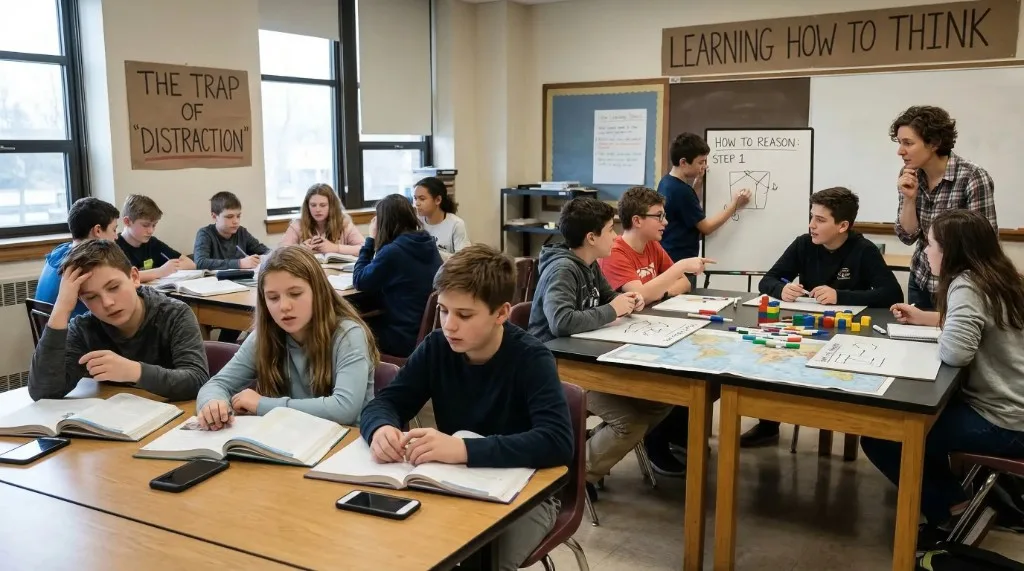
A few weeks ago, I spent the day at Fallon Middle School as a career speaker. Instead of a standard lecture, I ran a "Problem-to-App" workshop — a live exercise where students had to think through a real-world problem and design a solution from scratch. No instructions. No template. Just a problem and forty minutes.
When school is out, many families look for the same structured stretch — explore our summer academic camps in Dublin.
What I saw split cleanly into two groups. One group locked in almost immediately. Within forty minutes, they had mapped a user persona, identified a core problem, and sketched a complete app concept. It was genuine innovation — and it was exciting to watch.
The second group struggled — not because they weren't smart or motivated, but because they didn't know how to start. They couldn't move from one step to the next without a nudge. They kept waiting for a correct answer that wasn't coming.
"It wasn't a focus problem. It was a thinking gap — and the difference between the two changes everything about how we respond as parents."
The Framing We've Been Getting Wrong
When I shared this observation publicly on Nextdoor, the response was overwhelming — hundreds of parents in our community recognized it immediately. But one rebuttal kept appearing, including from AI tools like ChatGPT: that children aren't losing analytical skills due to distraction. Rather, they were never taught these skills in the first place.
Here's the thing: that's not a contradiction. It's a clarification — and an important one.
Both framings are partially true. The strongest version holds both at once: passive consumption — hours of algorithmically curated content, step-by-step YouTube tutorials, AI-generated answers — hasn't just distracted children from thinking. It has occupied the developmental space where analytical thinking was supposed to be built. The skill was never installed because there was never a gap in the stimulation long enough for it to grow.
Screen time didn't steal analytical thinking from our kids. It filled the space where that thinking was supposed to develop. It's not that the skill was lost — it's that it was never given room to grow.
What the Research Actually Says
This isn't just a classroom observation. The data is consistent across educational research.
A 2025 review in Frontiers in Education found that education systems worldwide continue to prioritize memorization and standardized testing over analytical thinking development — meaning most students are never explicitly taught how to break a complex problem into smaller parts.
A separate study on AI's cognitive impact found a measurable negative correlation between frequent AI tool usage and independent reasoning ability. Offloading thinking — even to useful tools — comes with a real cognitive cost when it replaces the practice of thinking entirely.
Perhaps most telling: research on students' tolerance for ambiguity shows that students raised in environments focused on finding the single "right answer" develop a measurably lower tolerance for the open-ended situations where critical thinking actually lives. If a child has only ever been asked to select from multiple choice, they will freeze when there isn't one.
Focus Problem vs. Thinking Gap — How to Tell
This distinction matters enormously for how you respond. A child who can't focus needs one kind of support. A child who was never taught to think needs a completely different one. Treating the wrong root cause wastes time and quietly erodes confidence.
- Struggles across all task types
- Can't focus even on preferred activities
- Consistent across all environments
- May benefit from medical or behavioral support
- Pattern doesn't change with structure
- Struggles specifically on open-ended tasks
- Can focus for hours on games or structured work
- Task-specific — not environment-wide
- Improves quickly when given the right framework
- Often misread as laziness or distraction
The child who plays Minecraft for four hours straight but cannot start a school project isn't attention-deficient. They're structure-dependent — they need the environment to do the thinking for them. That is a thinking gap, and it responds well to the right kind of practice.
I've put together a full PDF playbook with a diagnostic checklist, a root cause framework, and 10 at-home exercises. Designed to share — no signup required.
Why This Is Actually Good News
Here is what gave me the most hope in that Fallon classroom: when I gave the struggling group the right structure — a simple framework for breaking a problem into steps — something shifted visibly. Students who had been paralyzed started moving. Not perfectly, but genuinely. The thinking was happening.
Research on adolescent cognitive development is clear: the analytical capabilities essential for modern success need to be stimulated, especially during the middle school years. The window is real — but it is not closed. Analytical thinking is a learnable skill. It responds to practice exactly the way a muscle responds to resistance training.
"The students who thrived weren't smarter. They had simply been given more opportunities to struggle productively — and taught that struggle was part of the process, not a sign of failure."
What you can do starting this week
You don't need a tutoring center to start closing the thinking gap. Ask your child to explain something they just learned as if you were six years old. Pick a real household problem and ask them to name three possible solutions and evaluate the tradeoffs. Resist the urge to give hints the moment they pause. That pause is the work.
In a world where AI can answer almost any question instantly, the rarest and most valuable skill will be knowing how to ask the right question in the first place — and having the patience to build toward the answer.
The free Thinking Gap Parent Playbook has a 10-sign diagnostic checklist, the three root cause framework, and 10 at-home exercises you can start this week.
I'm happy to have a no-pressure conversation about your child's specific situation — whether or not it involves my programs.